Introduction
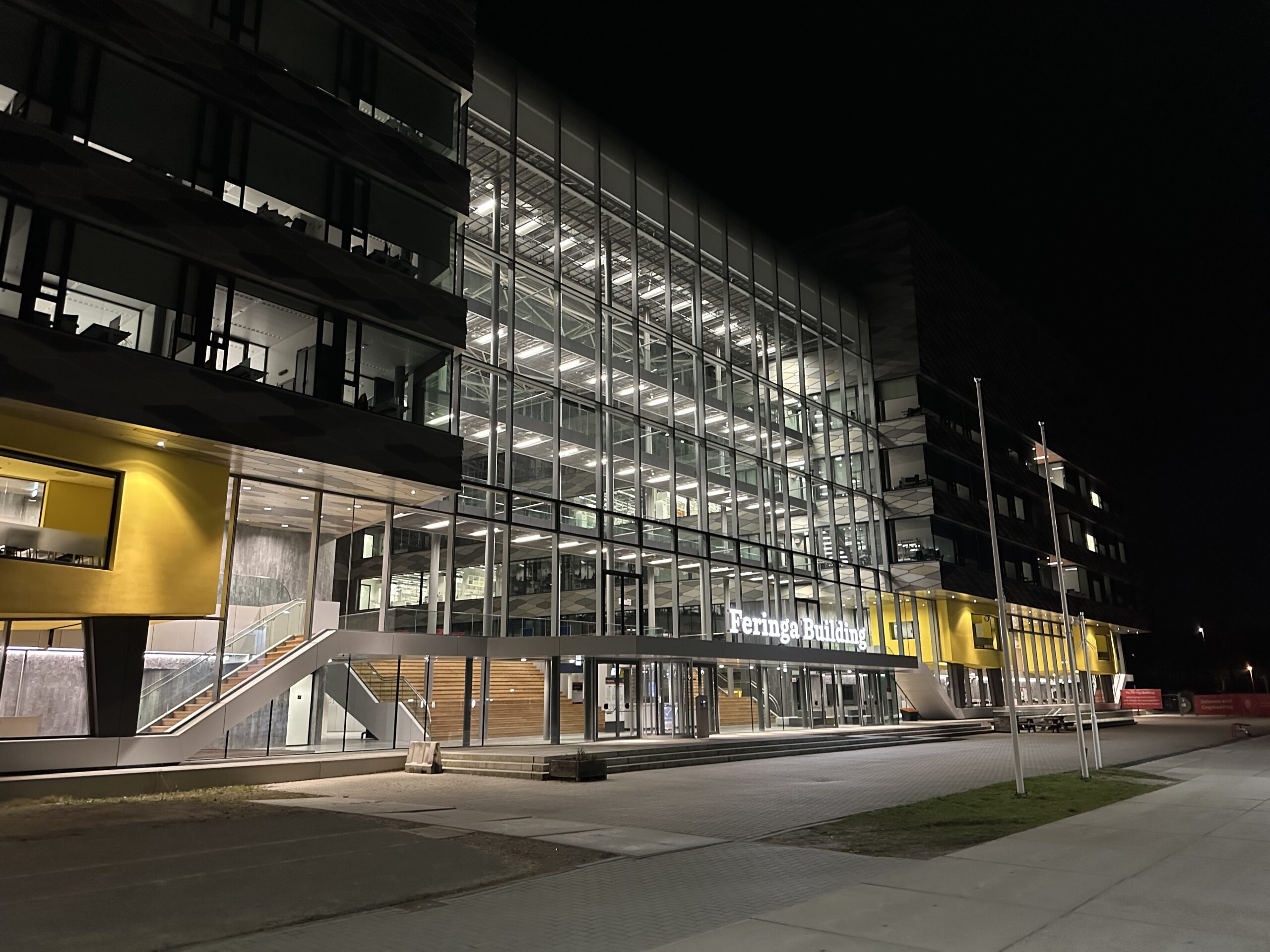
NaSuNe-ssNMR is a collaborative consortium project funded by the Dutch NWO funding agency, aimed at spectroscopic analysis of Nanomaterials, Surfaces and Non-Equilibrium conditions. This national consortium is centered on a newly established instrumentation facility at the University of Groningen, located at the Zernike Institute for Advanced Materials (ZIAM). The facility is managed and operated by the Solid-state NMR group of ZIAM, headed by Prof. Dr. Patrick van der Wel. Located in the new Feringa Building, the facility enables advanced solid-state NMR spectroscopy measurements enhanced by dynamic nuclear polarization (DNP) and in-situ irradiation.
Goals and targets
The NWO-funded facility is designed to allow atomic-level analysis of chemical processes and structures at the surfaces of (and within) functional nanomaterials, porous materials as well as biological assemblies. Often, the unique functional properties of materials (such as catalysts) derive from molecular processes occurring at the interface between dynamic liquid phases and ordered ‘solid’ phases. Traditional methods based on diffraction or solution analysis are often unable to properly analyze the chemistry and dynamics occurring at these interfaces. The NaSuNe facility features complementary specialized capabilities based on advanced instrumentation for solid-state NMR, high-resolution magic angle spinning (HR-MAS) NMR and dynamic nuclear polarization (DNP). In addition, the facility features the ability of in-situ irradiation during MAS NMR studies (as illustrated in published work). Combined, the facility can offer comprehensive NMR-based chemical and dynamic analyses of structures and processes at the surfaces of nanomaterials and bio-assemblies. The NaSuNe consortium will deploy this facility to tackle a variety of pressing scientific challenges in such topics as energy materials, circular materials, biomedical engineering, biochemistry, and heterogeneous catalysis.
Instrumentation
The full capabilities of the NaSuNe-ssNMR facility are still being developed, with instrumentation slated to be installed in 2026 and 2027, with ongoing development continuing subsequently. Currently, access to in-situ irradiated ssNMR (at 600MHz) is operational, with limited capacity, with additional capabilities following in due time. Additional instrumentation will include advanced variable temperature ssNMR at 400 MHz, combined with DNP-enhancements (at low temperatures near 100K). Additional in-situ irradiation capabilities will also be added, along with comprehensive multiphase (CMP) MAS NMR measurements of samples with complex dynamic properties. This website will provide updates, as more capabilities come fully online.
The NaSuNe-ssNMR consortium
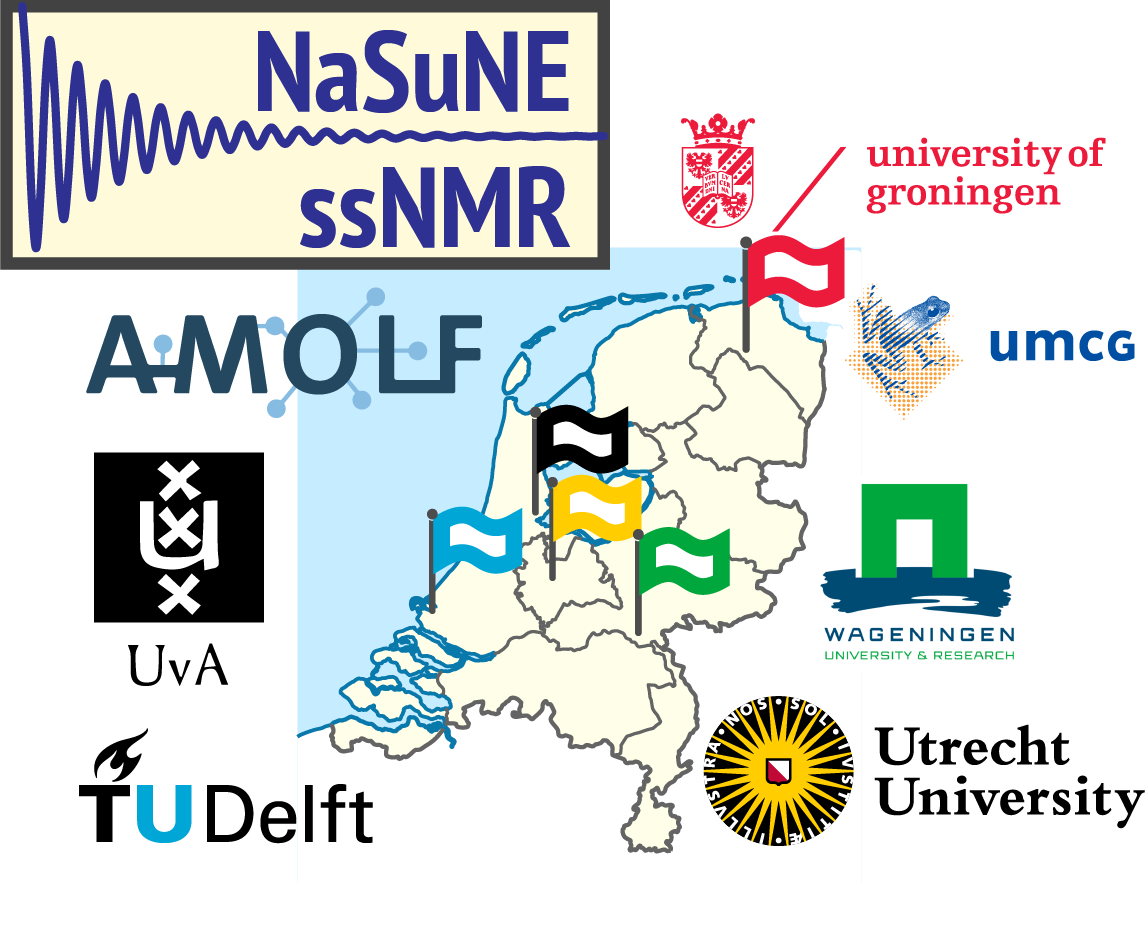
This facility is funded by a NWO consortium grant, based on the needs and plans of a national consortium involving researchers from universities across the Netherlands. At the University of Groningen, this includes researchers from the Zernike Institute, the ENTEG institute and the Stratingh Institute. Additional consortium members come from the University of Groningen Medical Center (UMCG), the University of Amsterdam, Wageningen University and Utrecht University, and Wageningen University
Inquiries and access requests
As the facility becomes fully operational, an application mechanism will be made available through this website. At the current time, please direct requests for information and/or access to the instrumentation via email to the address p.c.a.van.der.wel@rug.nl.
Related publications
Below is a selection of recent publications from consortium members, which illustrate the aims and scope of our interests. In due time, we will add publications derived from the NaSuNe project itself.
- Ji, Yanjing, Ruichen Zhang, Dongyi Xu, et al. “Metronidazole‐Loaded Cyclodextrin Nanogels for Antibacterial Therapy and Microbiota Regulation in Periodontitis.” Advanced Healthcare Materials, October 28, 2025, e02965. https://doi.org/10.1002/adhm.202502965.
- Lasorsa, Alessia, Pieter Van Der Meulen, Ernst Naumann, et al. “Probing Photochemically-Induced Dynamic Transitions by Magic-Angle-Spinning NMR Combined with in-Situ Irradiation.” Journal of Materials Chemistry A 13 (2025): 36318. https://doi.org/10.1039/D5TA06364G.
- Parlato, Raffaella, Greeshma Jain, Alessia Lasorsa, and Patrick C. A. Van Der Wel. “Probing How Anti‐huntingtin Antibodies Bind the Fibrillar Fuzzy Coat Using Solid‐State NMR.” Chemistry – A European Journal 31 (July 2025): e01676. https://doi.org/10.1002/chem.202501676.
- Slama De Freitas, Ana Luiza, Tim G. W. Engels, Salvador Bertran Llorens, et al. “In-Depth Characterization of Tertiary Cellulose from Wastewater Treatment Facilities.” Biomass and Bioenergy 210 (July 2026): 109012. https://doi.org/10.1016/j.biombioe.2026.109012.
- Spagnuolo, Laura, Alessia Lasorsa, Rosarita D’Orsi, et al. “Candida Rugosa Lipase Bioconjugation to Cellulose Nanocrystals with High Immobilization Efficiency: Comparison with Nonspecific Approach.” Biomacromolecules 27, no. 2 (2026): 1612–24. https://doi.org/10.1021/acs.biomac.5c02245.