Blog Posts

Publication: Review article on polyglutamine protein analysis by solid-state NMR spectroscopy.
Our new review article summarizing progress in polyglutamine protein studies by solid-state NMR is now available on the website of the journal Biochemical Society Transactions. This is an invited mini-review that was requested to cover the progress made in our understanding the aggregation and misfolding of mutant polyglutamine proteins implicated in diseases such as Huntington’s disease and several versions of spinocerebellar ataxia (SCA). We describe how studies from ssNMR has been used to better understand the structure of these protein aggregates, and thus helps us analyze how the aggregation process occurs and how aggregates may play a role in these […]
Publication: collaborative paper on perovskite-related materials, with Sn and Se ssNMR
Congrats to our collaborators from the group of Maria Loi and others for the publication of their new paper on in situ SnSe deposition as passivation for scalable and stable quasi-2D lead–tin perovskite solar cells, in the journal Energy & Environmental Science. Dr. Lasorsa in our group contributed tin and selenium ssNMR analysis to this interdisciplinary paper. For more information see the paper at the journal. Publication: Chen L, Tekelenburg EK, Gahlot K, Pitaro M, Xi J, Lasorsa A, et al. In situ SnSe deposition as passivation for scalable and stable quasi-2D lead–tin perovskite solar cells. Energy Environ Sci. 2023;10.1039.D3EE02507A.
Educational webinar on the use of ssNMR to measure dihedral angles.
Recently, Patrick gave an online lecture in the online webinar tutorial series of the Global NMR Discussion Meetings series (episode 70!). In this online lecture he introduced and discussed approaches to measure torsion angles (or dihedral angles) using advanced solid-state NMR spectroscopy. He discussed the basic idea of how these are implemented in ssNMR, but also how such structural data can be a useful complement to more traditional inter-atomic distance information obtained by ssNMR. You can now watch the recording of this lecture on Youtube, via this link. Want to learn even more? This lecture is connected to our recent […]
Publication: Dynamics-based spectral editing to see (fiber) surfaces by solid-state NMR.
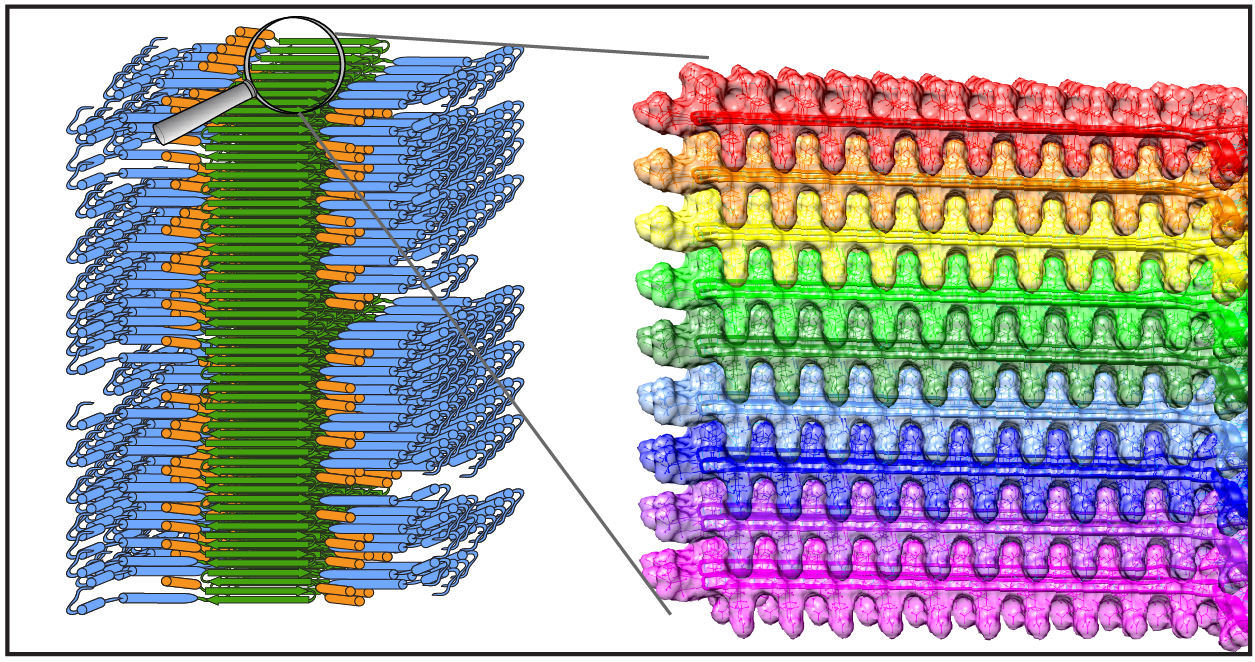
Congratulations to Dr. Irina Matlahov and (alum) Dr. Jennifer Boatz on the publication of their new paper in the Journal of Structural Biology X. The paper is entitled “Selective observation of semi-rigid non-core residues in dynamically complex mutant huntingtin protein fibrils“. It describes our latest research on the misfolded protein deposits associated with Huntington’s disease (HD), specifically looking at what happens on the surface of these protein fibrils. In previous work we have studied the structure of these nanometer-sized fibrils formed by mutant huntingtin’s exon 1 fragment, using ssNMR, EM and other methods. In our earlier studies we used dynamics-sensitive […]
News: Dutch-language radio
Recently our research was covered (briefly) on a Dutch radio station, featuring an interview with Patrick. It is mostly about our work applying ssNMR to studying how proteins aggregate in Huntington’s disease. You can find the recording online at the NPO radio website. More information about our Huntington disease research can also be found on this page, and in two recent webinars.
Publication: SSNMR of alginate hydrogel (re)hydration
A new open-access publication by Mustapha and collaborators has been published in the journal Food Hydrocolloids, describing how he used various ssNMR measurements to probe alginate hydrogel structure and (re)hydration. Alginates can be cross-linked with calcium to form hydrogels, which are used in many different types of applications. This includes their use in slow-release drug delivery as well as food/nutritional applications. In this new paper, Mustapha shows how 1H, 2H and 13C ssNMR measurements can be used to see how these hydrogels are structured, but especially also how they are hydrated by the aqueous solvent. A key feature of the […]
Publication: New paper on mitochondrial protein-lipid interactions published in PNAS.
Congratulations to lab alumns Dr. Abshishek Mandal and Dr. Jennifer Boatz, as well as our collaborators in the USA and Spain! A new collaborative paper on mitochondrial protein-lipid interactions has just been published in the journal PNAS. In this multidisciplinary work we studied how the protein Drp1 binds the special mitochondrial lipid cardiolipin in order to do its job managing the proper fission of mitochondrial membrane. Our collaborator Rajesh Ramachandran (at Case Western) coordinated a wide array of experimental and computational approaches to determine how Drp1’s “variable domain” (VD) binds cardiolipin. Along the way, two apparent CL-binding motifs were detected, […]
New (e)book on membrane studies by solid-state NMR released online.
Now available online: we have contributed a chapter to a new (e)book on the topic of solid-state NMR studies of membranes and membrane proteins, edited by Frances Separovic and Marc-Antoine Sani (Univ. Melbourne, Australia). The edited volume “Solid state NMR. Applications in biomembrane structure.” was released in the IOP series in association with the Biophysical Society. Our chapter (Solid-state NMR studies of peripherally membrane-associated proteins: dealing with dynamics, disorder and dilute conditions [1]) looks at several studies that use ssNMR to probe peripheral membrane proteins. A key focus is on our own work on the mitochondrial protein cytochrome c, and […]
New publication on structure of mutant huntingtin protein from Huntington’s Disease
Congratulations to Dr. Jennifer Boatz and other team members for the acceptance and publication of a nice new paper on the structure of the misfolded mutant protein from Huntington’s disease. The paper is online at the Journal of Molecular Biology. Based on an integration of multiple techniques (NMR, EM, and X-ray diffraction), Jennifer assembled a new structural model of the protofilaments that make up the hierarchical fiber architecture of mutant huntingtin exon 1. This is a timely and important step forward in our understanding of the (mis)behaviour of the HD protein, and in particular how it forms pathogenic inclusions and […]
Competitive PhD Scholarships call open (deadline April 1st)
Our Institute and Faculty have opened up a competitive call for PhD scholarship applications. Our solid-state NMR group participates in one of the research theme areas, designated as “Advanced Materials”, which spans topics from physics of life, via bio-inspired materials, to materials and much more. The process is described in some detail on the RuG website. Briefly, applicants (with a MSc degree) are expected to contact a PI/supervisor (immediately!) and develop a fitting project to submit. The submission deadline of an initial idea (few hundred words) is due by April 1st 2020! Suitable ideas are expected to fit within designated […]
Dutch Huntington Research meeting back in Groningen – Sept. 2nd 2026
The Dutch Huntington Disease Research Network (DHDRN) symposium is again coming to Groningen. This time it will take place on September 2nd 2026 at UMCG. This recurring symposium brings together the community of Huntington’s disease researchers from across the Netherlands. The focus will be on research into molecular mechanisms relevant to the disease, with three invited speakers alongside a selection of submitted abstracts. All researchers, companies and health professionals with an interest in Huntington’s disease are invited to join the meeting. For registration and more information, please contact g.noppert@umcg.nl at UMCG. The 2026 version is being organized by: Michael Chang, […]
Funding: project grant from CampagneTeam Huntington
We are very grateful for the continued support from the Dutch CampagneTeam Huntington foundation (CTH), which has just announced that they will fund our new project grant on Huntington’s disease (HD). This is a project together with our longstanding collaborator Prof Amalia Dolga (at the GRIP institute of the University of Groningen). It is an extension of an earlier project that the CTH funded, and which paid for the PhD research project of Dr. Greeshma Jain. She published several papers from her research on the structures and toxic properties of HD-related protein aggregates and how they are modulated by aggregation […]
Postdoc position available – ssNMR/DNP
We are looking for a postdoctoral researcher to join the group, funded by our new NWO WINC grant. See the application site of the university for now. The Solid-state NMR group of Prof Patrick van der Wel at the University of Groningen is looking for a postdoctoral researcher with experience in magic-angle-spinning (MAS) solid-state NMR spectroscopy and/or dynamic nuclear polarization (DNP). The multiyear postdoctoral position is funded by the Dutch national funding organization NWO, via a national consortium grant that establishes a new ssNMR/DNP facility in Groningen. The postdoc will join the Solid-state NMR group supervised by Prof. Patrick van […]
Publication: In-situ irradiated MAS NMR to probe dynamic transitions.
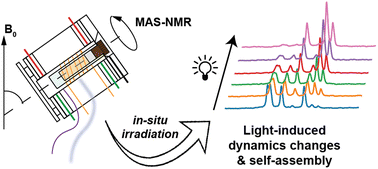
We are excited to report the publication of our paper on in-situ illumination during MAS NMR in the Journal of Materials Chemistry A. This publication is the culmination of a long project that found its origins quite a few years ago, even before the lab moved from Pittsburgh to Groningen. Photochemistry and optogenetics are increasingly influential topics in both chemical and biological research, respectively. The application of illumination and light triggers can be used to control chemical and biological processes. In this paper we focus on the intersection of such processes and materials science – demonstrating how magic-angle-spinning (MAS) NMR […]
New Publication: Silk-inspired hybrid materials – ssNMR and more.
Congratulations to PhD student Raffaella Parlato, as well as our collaborators from the group of Marleen Kamperman, with the publication of a new collaborative paper in the journal Communications Chemistry. Raffaella used solid-state NMR to study the structure and dynamics of (labeled) polypeptides within the hybrid polymer-peptide materials prepared by the Kamperman group. The employed peptides are poly-alanine peptides inspired by the structural motifs found in proteins in spider silk. Spider silk proteins use polyalanine segments to form stable higher order structures that enable the remarkable materials properties of silk. Here, these peptides were used to change the materials properties […]
Publication: how antibodies bind to the fuzzy coat of Huntingtin protein fibrils.
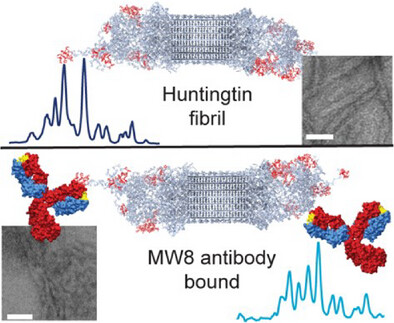
Congratulations to Raffaella for the publication of her second first-author paper, this time on the use of NMR spectroscopy to study how antibodies bind to the aggregated state of huntingtin protein fragments, relevant to Huntington’s disease. This work is part of our ongoing research on the biochemistry of Huntington’s disease, and was supported by funds from the European Huntington Disease Network EHDN and the CampagneTeam Huntington. Antibodies are widely used as diagnostic tools in HD research, and also are considered as potential treatment modalities. An example of the latter approach can be found in the case of Alzheimer’s disease, where […]

Publication: Impact of aggregation inhibitors on protein aggregation and aggregate toxicity.
Congratulations to Greeshma Jain, Marina Trombetta-Lima and the whole team of co-authors for the publication of our most recent paper on Huntington’s disease (HD), in the journal Nature Communications. This paper is actually the fourteenth peer-reviewed publication from the lab on HD research, since our first paper in 2011. It was enabled by crucial funding from the CampagneTeam Huntington foundation, who supported our HD research program when the Van der Wel group moved back to the Netherlands. In this new report we describe our use of structural analysis (NMR and EM) to look how aggregation-inhibiting small molecules (polyphenols) change the […]
Webinar: GlycoScience Webinar on polysaccharide ssNMR research
On 27 March Patrick gave an online presentation in the EGC webinar series, on the topic of using solid-state NMR (and isotope labeling) to study polysaccharides in various contexts. The title of the presentation was: “Labeling and solid-state NMR studies of hyaluronic acid and other polysaccharides: hydrogels, nanoparticles and more” EGC Webinar #86 Glycochemistry (March 27, 4 pm CET) Patrick van der Wel (Zernike Institute for Advanced Materials, University of Groningen, the Netherlands) “Labeling and solid-state NMR studies of hyaluronic acid and other polysaccharides: hydrogels, nanoparticles and more” A recording of the lecture is visible via YouTube. In the presentation […]
Publication: Protocols for membrane protein studies by solid-state NMR (including drug interactions)
Our invited ‘protocol’ paper is now available in the journal Protein Science (Protein Society), authored by Alessia Lasorsa and Patrick van der Wel. In this report we described our “Solid-state NMR protocols for unveiling dynamics and (drug) interactions of membrane-bound proteins”. This paper was based on an invitation to contribute to the “Tools for Protein Science 2025” special issue. We opted for contributing a discussion of how we use solid-state NMR to probe membrane-bound proteins. More specifically, we summarized protocols we developed in years of work on mitochondrial lipid-protein interactions. A special focus in the report is on some recent […]
Publication: Peptide-based self-assemblers and self-replicators (with insights from ssNMR).
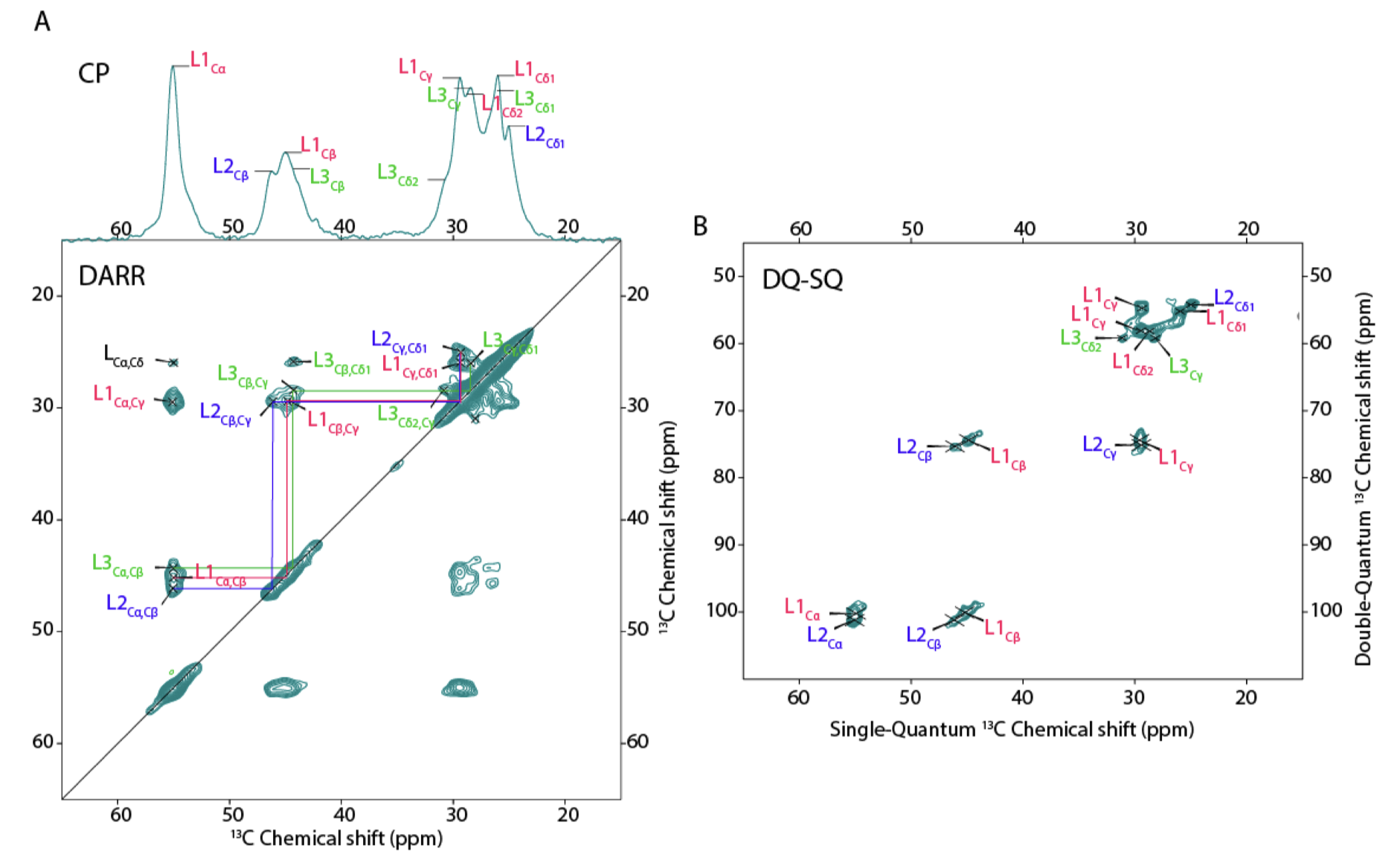
Congratulations to our collaborators in the group of Sijbren Otto (RUG), and Alessia, for the new paper in the journal Chem. This report discusses how self-assembling and self-replicating molecules can borrow principles from polypeptide amyloid formation. In particular, the concept of ‘steric zippers’ proves to be highly relevant – an idea from the amyloid field that comes out of seminal work by the group of David Eisenberg (UCLA). Our contributions in this new paper relate to the use of 1D and 2D solid-state NMR analysis of the self-assembled materials, in samples where targeted isotope-labeled amino acids were incorporated. With these […]