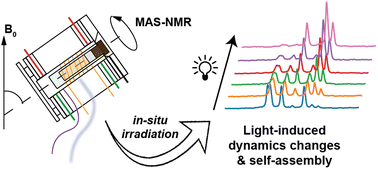
We are excited to report the publication of our paper on in-situ illumination during MAS NMR in the Journal of Materials Chemistry A. This publication is the culmination of a long project that found its origins quite a few years ago, even before the lab moved from Pittsburgh to Groningen. Photochemistry and optogenetics are increasingly influential topics in both chemical and biological research, respectively. The application of illumination and light triggers can be used to control chemical and biological processes. In this paper we focus on the intersection of such processes and materials science – demonstrating how magic-angle-spinning (MAS) NMR can provide insights into the chemical and dynamic aspects of light-induced physical and chemical transformations. One the one hand, the paper describes our implementation of in-situ illumination, using affordable LED light sources with optical fibers to accomplish efficient in situ irradiation. It also describes some work arounds needed for combining illumination with MAS rotation and detection. Finally, we describe our (surprising) observation that not only sapphire but also zirconia rotors can be useful in these studies.
Thanks to our great collaborators at the RUG, we also illustrate the use of this hardware on several relevant sample types. This includes UV-hardening materials (with Katja Loos), as well as azobenzene photo-switches (with Wiktor Szymanski, Michael Lerch and Ben Feringa). Using solution samples (including a chemical actinometer) we test the high illumination efficiency. With semi-solid samples we show the ability of dynamic spectral editing to probe changes in dynamics that accompany photochemical reactions. In particular, the latter approach allows for the tracking of (dis)assembly processes that are directly or indirectly triggered by light.
For more details, see the paper! By the way, this paper was published in a special collection honoring our Zernike Institute colleague Prof. Dr. Petra Rudolf.
Reference: Probing photochemically-induced dynamic transitions by magic-angle-spinning NMR combined with in-situ irradiation. Alessia Lasorsa, Pieter van der Meulen, Ernst Naumann, Michael M. Lerch, Maria Rosa Marquez-Garcia, Xiaohong Lan, Katja Loos, Ben L. Feringa, Wiktor Szymanski & Patrick C.A. van der Wel* (2025) J. Mat. Chem. A DOI: https://doi.org/10.1039/D5TA06364G
Data: published data are available via Zenodo or on request.